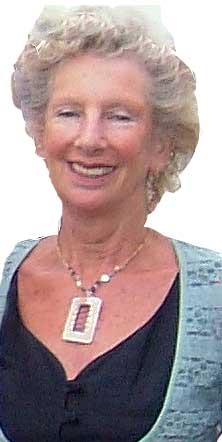
 Seeding Cafés from a Compassionate Heart
From an interview with Trish Dickinson
Trish Dickinson may have spread Conversation Cafés more widely than most any other 10 people outside of CC’s home office in Seattle. From peace activists in the Occupied Territories to educators in Hungary to ecological agriculture innovators gathering in Portugal, Trish offers her twin passions of Conversation Cafés and Nonviolent Communication without hesitation wherever she goes.
Trish–who makes her home in Birmingham in the U.K.–first encountered CCs at Schumacher College in 2003, on a course for international peace activists. She had been working as a Nonviolent Communication trainer for 12 years, and was looking for a way to give people an entry-level or “taster” experience of a communication process that many people find difficult. She says, “The whole of me just said YES when I met Vicki.” (Vicki Robin, a co-founder of Conversation Cafés, was one of the tutors on the course.)
So, in January of 2004, Trish launched her own Conversation Café Movement. Adapting the original Process and Agreements slightly, from its native American idiom to a version more harmonious to European ears, Trish had 1,000 CC wallet cards printed at her own expense. She says she finds the cards “perfect in their neatness … beautiful tactile things” that she can easily pass along to colleagues, conference planners, and people she meets on planes, buses, peace demonstrations, and anywhere else she happens to be. And with the card, Trish empowers the recipient to take the process and run with it, to use it in whatever way it may serve their own peace- or community- growing projects.
Folks who have nurtured Trish's CC seeds include a visiting colleague from Africa, who recognized that the CC process and agreements have a basis in traditional, ancient wisdom. After 8 years of doing Nonviolent Communication training with Kenyan peace activists at locations in the U.K., Trish was invited to visit their Peace and Conflict group in North Kenya. There she learned that young activists are integrating nonviolent mediation into school programs, and also between schools, and that the Kenyan government has asked them to expand their program into schools across the country. Trish observed that people in Kenyan communities are moved by the Conversation Café format, as they understand it to be based on traditional village practices of bringing all who are affected by a problem into a circle to listen to one another. They see CCs as a means to truth and reconciliation, and sometimes refer to them as “Compassionate Café” or “Nonviolent Café.”
In 2004, Trish worked with colleagues from Bethlehem who are based in an international peace center and school that focuses on nonviolence. Their war trauma unit uses a version of the CC process and agreements that they have translated into Hebrew and Arabic, and the center is also offering CCs in conjuction with two weeks of planting peace trees in the summer of 2005.
Also in 2004, TAMERA—a global institute for peace building—ran a two-week program in Portugal called A Future without War. When Trish noticed the issue of fear coming up repeatedly, she suggested holding a CC on that theme. Recruiting volunteer hosts from each language group, Tamara briefly introduced them to the CC process and agreements, and then walked continually through the CC gathering, listening and checking in as the 85 participants, with their German-, Portuguese-, English-, Arabic- and Hebrew-speaking hosts, “went very, very deep” in their conversations.
In all this, Trish says: “I’m going where there is energy and not pushing the river … I feel like the poem in The Prophet by Gibran: ‘I am responsible for the seed, and the blossom, and not where the fruit drops.’ This helps me to be looser about solutions and be more with the process. If I can do this in my life, I find more, other and varied solutions evolve, rather than the one I thought was best and only!”
When folks respond to an introduction to CCs with “I’d love to do it, but …” Trish chooses not to put organizing energy in their direction. However, when people respond with enthusiasm, and perhaps a specific request for a “practice” CC, or Trish's support and presence for a first Café gathering, Trish says: “I’m delighted and pleased to participate. I’m very happy to keep in touch, to hear their progress and give feedback when hosts feel challenged or stuck. To be asked in. To share a day or a workshop if that’s what people want.” These days, Trish reports: “I’m enjoying the word movement. I just go with the responses, really. I want to remain light, and not keep ownership. I don’t have a need or a hunger for keeping tabs on everything. For me, this has the essence of non-stagnation.”
And the conversations go on. This autumn, Trish will be collaborating with the Global Ethics Department of the University of Birmingham to offer a theme-based Conversation Café on the question: “How can we develop into a fair trade university?”
P.S. If you know of another enthusiastic CC seeder, or are one yourself, we’d love to hear your stories. Please get in touch with Claudia at [email protected].